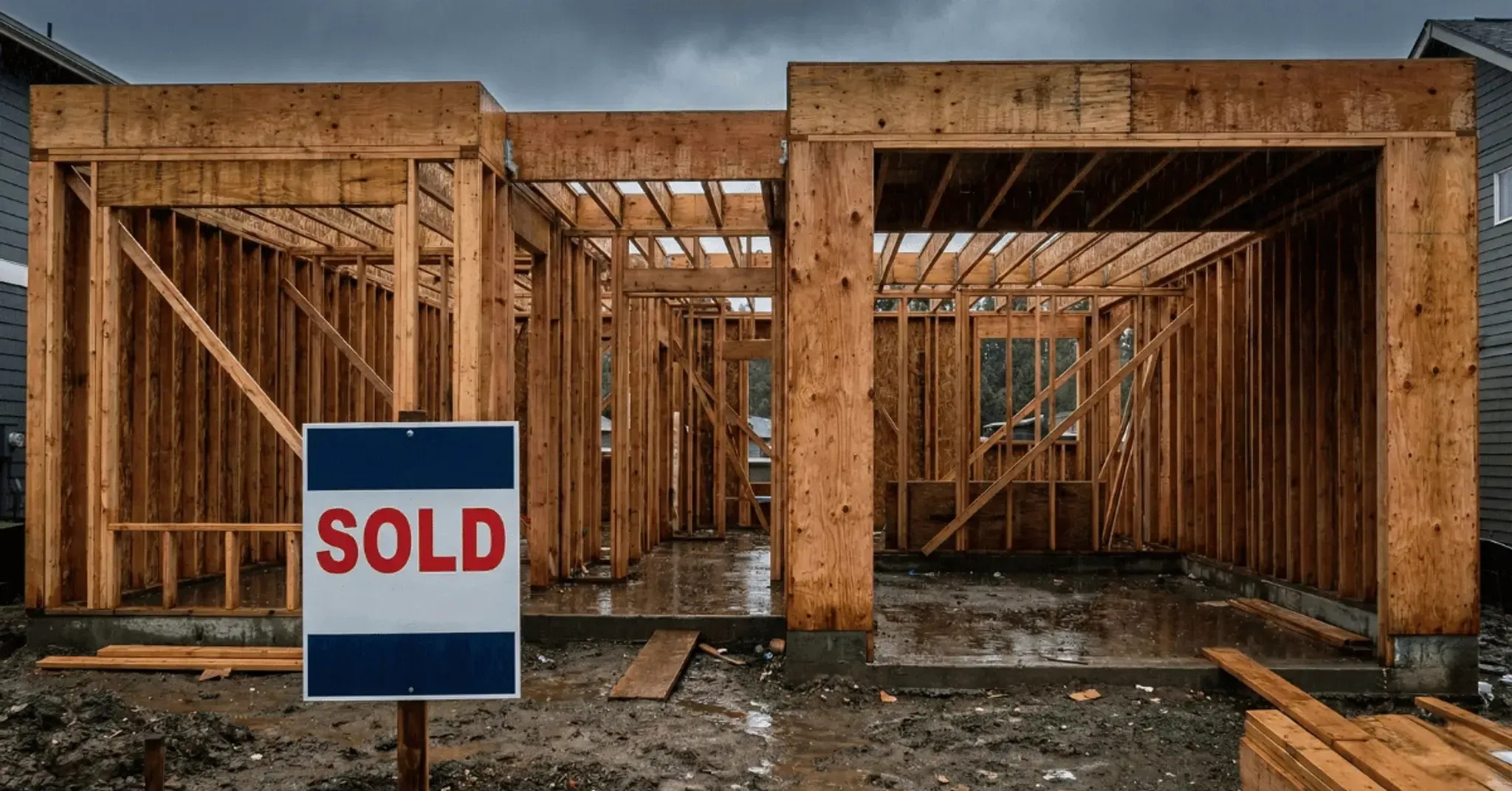

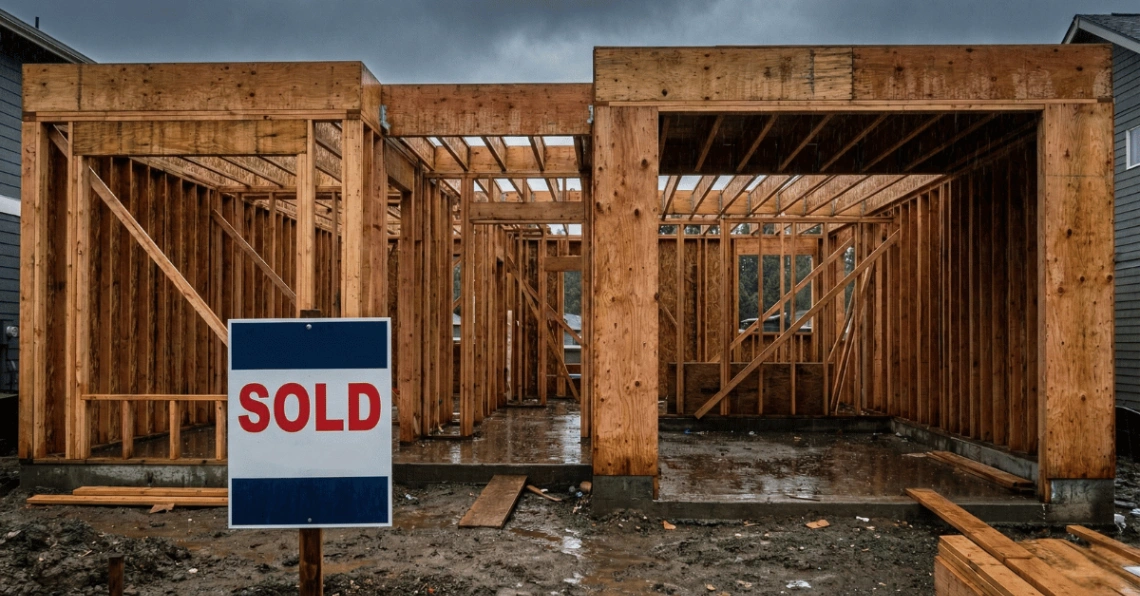
Seattle's new-construction boom and its rainy season share the same calendar. The city logs more than 150 rainy days a year. Builders do not stop framing or sheathing homes when it rains.
Wood gets wet on site. The walls close over it.
According to the U.S. EPA's mold guidance, mold begins to grow within 1-2 business days of moisture exposure. Most new homeowners find out about this problem years later, during a pre-sale check, or when the buyer's inspector opens the attic hatch and won't let the deal close.
How Moisture Gets Locked Into a New Seattle Home
OSB, or oriented strand board, is the standard wall and roof sheathing in Seattle new builds. Unlike old-growth lumber, OSB is made from wood chips pressed together with resin. It takes in water fast and dries slowly.
When OSB sits exposed to rain during framing and house wrap goes on before the wood dries, the moisture is sealed in. Washington State's marine air holds between 70 and 80 percent humidity through the rainy season. Wood that soaks up rain in October can stay at unsafe moisture levels through February with no way to dry out.
There is no state code rule that tells builders to test wood moisture before closing walls. Most don't. Final inspection does not check for it either.
Concrete adds a second source. A new slab gives off water vapor as it cures. That process goes on for months. In a sealed new build, that vapor rises into wall gaps where insulation takes it in and holds it against the framing.
Why Attic Mold Is the Most Common Finding in Mold in New Construction Seattle
Warm air from the living space rises. When ceiling gaps are not sealed, that humid air moves into the attic. Washington State code under IRC R806 sets a rule: one square foot of net free vent area per 300 square feet of attic floor. Half must come in at the soffits, half must exit at the ridge.
When that split is off, humid air stalls. It hits the cold underside of the roof sheathing and turns to condensation. Over a Seattle winter, that cycle alone is enough to grow mold on OSB without a single roof leak.
Peter Kakoczky of Mold Solutions NW, who has inspected more than 4,000 Puget Sound attics, names three failures as the most common causes of attic mold in the region. First, insulation baffles fall and block soffit vents.
Second, ridge vents are sized to the minimum code spec, not the real volume of the attic. Third, bath fans vent into the attic instead of outside. All three are code issues. None tend to get caught at final inspection.
The mold that grows on OSB sheathing in these conditions is almost always Penicillium or Cladosporium. Neither is Stachybotrys, the toxic black mold, which needs standing or dripping water to grow.
Both species eat away at sheathing over time. When the growth gets dense enough, it bleeds through the ceiling below as dark lines that follow the path of the joists. By the time you can see that from inside the room, the problem above is already advanced.
The Builder Defect Window and Why an Inspection Is a Record, Not Just a Test
Washington State's construction defect laws give homeowners a limited time to bring a claim against a builder. Mold tied to wet framing or a vent system that never met code can qualify as a defect. Once that period closes, the fix is yours to pay for.
Mold removal in Seattle homes runs $2,000 to $6,000 for mid-size cases, based on regional industry data. Attic cases often cost more when sheathing must come out rather than get treated. An inspection now creates a dated record of what was found and what likely caused it.
That record matters for two reasons. It tells you whether the source is from the build or from how the home is used, which changes how the problem gets fixed. And it gives you something to act on while the builder's defect period is still open.
A report from an inspector who also sells cleanup has a built-in conflict. One from an inspector with no stake in what removal costs does not. Fast Mold Testing's inspection-only model means the report's only job is to tell you what is there.
Frequently Asked Questions
Is mold from attic condensation treated the same as mold from a roof leak?
No. Condensation mold on dry sheathing can sometimes be removed with dry-ice blasting or sanding if the wood is still sound. Mold from a roof leak usually means removing and replacing the sheathing, because the wood beneath is damaged. A moisture reading at inspection tells you which case you are in before you spend money on removal.
Can I check attic venting myself before calling an inspector?
You can do a basic check. In the attic, look for insulation pushed up against the eaves, which blocks soffit intake. Trace each bath fan duct from the housing to confirm it connects to a roof cap or wall vent, not a loose end in the attic.
At the ridge, check that the vent runs the length of the roof. To measure actual airflow, a certified inspector uses a balometer. A visual check tells you if there is an obvious block. It does not tell you if the system is balanced.
Why does a conflict-free inspection carry more weight in a builder defect claim?
An inspector who also offers cleanup earns money when problems are found. A builder's insurer or a court reviewing that report will note the tie. An inspector with no stake in what removal costs produces a finding that is harder to challenge. The Washington State Department of Health recommends professional testing when hidden mold is suspected, which also creates a trusted baseline for any claim that follows.
What Builders Know That Most Buyers Don't
Seattle builders are not cutting corners by design. They work on handover dates set before anyone checked the fall weather. Framing gets wet because the schedule demands it. Walls close because the close date demands it.
The result is a problem built into the process, not a personal failing. That also means it is predictable.
Predictable problems can be found while you still have standing to act on them. If your Seattle home was built in the last few years, schedule a conflict-free mold inspection while the defect window is still open. If you want to know what you can assess on your own first, Fast Mold Testing's DIY testing guide covers the steps before a professional visit.
Frequently Asked Questions
- Why does mold develop in newly built Seattle homes before owners even move in?
- New construction in Seattle often sits partially enclosed during the wet season, with framing and sheathing exposed to rain before windows, doors, and roofing are complete. Lumber that absorbs moisture during construction can develop mold inside wall cavities that gets sealed in when drywall is installed. Owners may not discover this until months after move-in when musty odors or health symptoms appear.
- How can Seattle buyers detect construction-phase mold in a newly built home?
- Seattle buyers of new construction should request a mold inspection before closing, ideally before drywall is installed if possible, or at minimum before taking occupancy. A professional moisture meter scan of wall cavities through electrical outlets and a comparative air sample can reveal elevated spore levels from construction-phase mold even after walls are closed. Fast Mold Testing provides this service starting at our transparent rate.
- Does a new construction warranty in Seattle cover mold that developed during the build calendar?
- Washington State's new construction warranty typically covers structural defects and water infiltration, but mold remediation coverage depends on how the policy is written and whether the builder acknowledges the moisture source. A pre-occupancy mold inspection report from Fast Mold Testing that documents elevated spore levels before the warranty clock starts is the strongest basis for a warranty claim.
- How much does a mold inspection cost for a new construction home in Seattle?
- Mold inspections for new construction homes in Seattle typically cost between $500 and $800 (more for extensive inspections). Fast Mold Testing starts at our transparent rate with results in 1 to 2 business days. The pre-occupancy inspection is the most cost-effective time to identify construction-phase mold because warranty remedies are still available and the builder is still accessible and motivated to resolve issues before final payment.