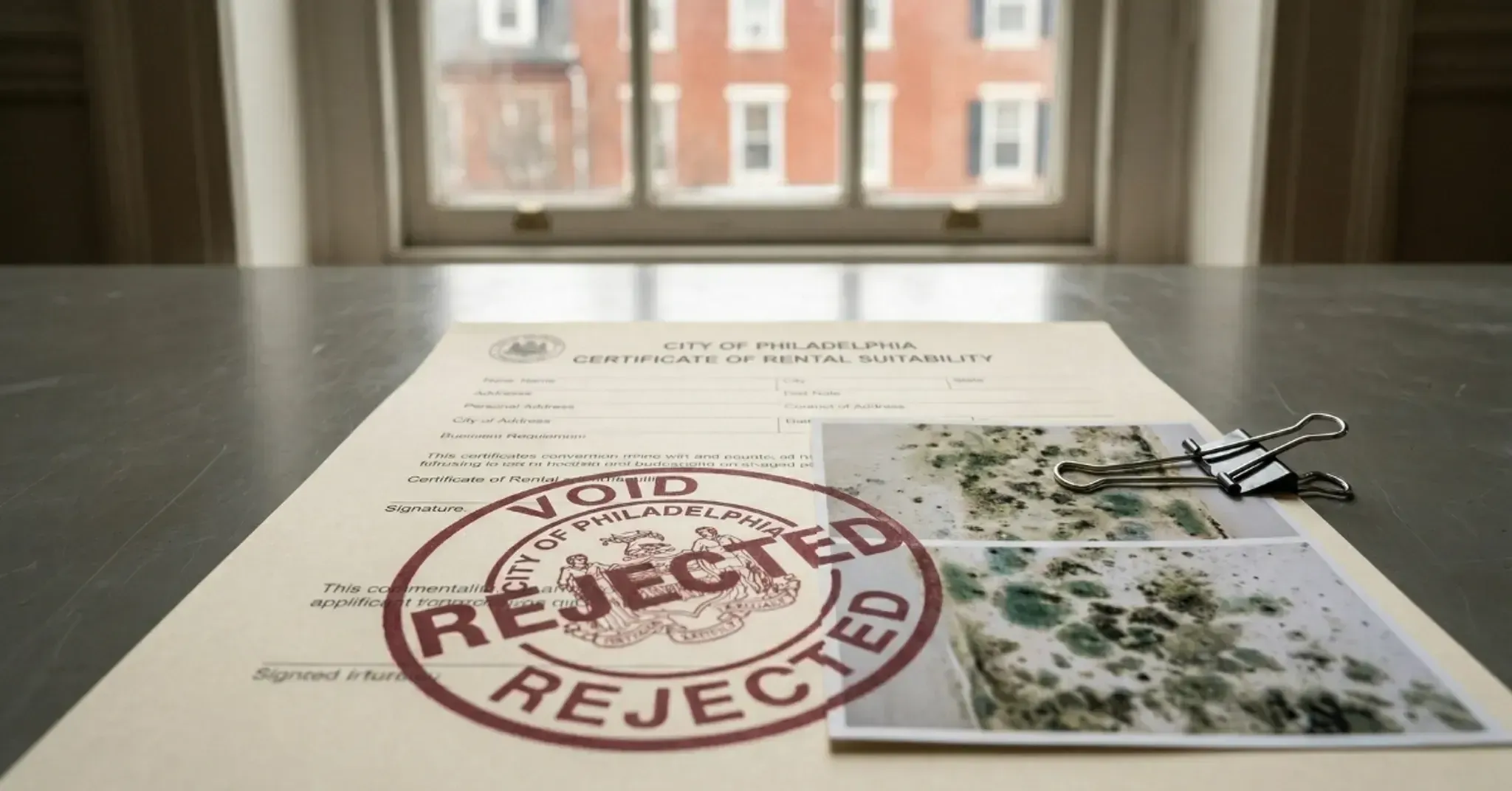

Every person who rents out homes in Philadelphia has to give the new person moving in a Certificate of Rental Suitability when they sign the lease. This certificate shows that the place is safe and clean. You sign it. The person moving in signs it, too.
If someone staying there finds mold two weeks after moving in, that paper is more than just a fix-it note. It turns into a legal issue. Your name on it says the place was clean and safe. Mold showing up so soon is hard to blame on a new person moving in. In Philadelphia, mold testing can cost from $500 to $800 (more for extensive inspections). Fast Mold Testing starts at our transparent rate, and you can get results in 1 to 2 business days.
What the Certificate of Rental Suitability Actually Says
Philadelphia's rental license rules say a landlord needs more than just a license. When a new person starts to rent, the landlord must give them a Certificate of Rental Suitability. This rule is part of the city's property code.
The CRS says the unit has an active rental license, passed its last look over, and is okay to live in. In Philadelphia, "fit to live in" has a real legal meaning. It means the unit does not have any things that are bad for health or safety. Mold you can see, or mold at levels that are bad for health, is one of these things.
When you sign the CRS, the person who owns the place says none of those things are there. People who own the place often see it as a simple form. A court treats it like a promise made under oath.
What Happens When a Tenant Finds Mold After Lease Signing
If you see mold in two weeks after you move in, this counts against the owner of the place. Mold does not grow that fast, in just 14 days.
Visible mold does not show up right away. It takes weeks or sometimes months to grow. If you see spots on the bathroom ceiling or a dark place on the wall behind the dresser, it's not fair to blame someone who just moved in. Housing court judges in Philadelphia know this because they deal with many mold cases.
The first thing the renter does is often to say something to the Department of Licenses and Inspections. L&I can come in and look at the place. If they find mold in the unit, a notice goes to the person who owns the place. A notice right after the lease has been signed, with the CRS form done, means the person who owns the place said yes without really looking it over.
Some people who rent their home take things to the next level. A report from a licensed Philly building checker, made right after move-in, is used as the main proof in a claim that something was not true. The person who owns the place said the home was good to live in. The report says it was not.
Why "I Didn't Know" Doesn't Hold Up
The most common answer from the person renting out the place to early mold complaints is simple. They often say: I walked through the place before you moved in and did not see anything. That can be true. The issue is that saying "I did not see it" and "it was not there" are not the same.
Mold can stay hidden in many places. It can be inside wall gaps, in HVAC systems, under tiles, and behind the fridge. A quick walk-through will not always show it. The CRS does not say "the place looked fine." It says that the unit is good for people to live in.
If the owner did not test before you sign, there is no way to show that they looked for more than what they could see. A mold test before you start the lease is the only real proof that the owner checked and did not just think all was alright.
What Between-Tenant Mold Testing Actually Costs
A mold check in a Philadelphia row house takes a few hours. The person who comes will check the air. They will test places that often get wet, like bathroom walls, basement ceilings, under sinks, and HVAC returns. The samples go to a lab.
Row house moisture has its own way of moving and acting, as explained in the guide to party wall mold in Philadelphia rowhouses.
That report can cost you from $500 to $800 (more for extensive inspections) for a full look. Fast Mold Testing will do it starting at our transparent rate. You get the results in about 1 to 2 business days.
When you think about it, this is like a fight. A mold complaint can start an L&I review, stop a rental license, send a notice for repairs, and a repair order. If the renter goes to court, you also get legal fees and moving costs if they say the place is not safe to live in. All of these costs together are almost never under $1,000.
Pre-tenancy testing does not cost a lot. It also gives the owner something that the CRS does not give. This is a record with a date that shows the unit was clean before someone moved in. If a renter says the owner knew about mold when getting the place, that report helps prove the owner is right.
Frequently Asked Questions
Does every Philadelphia landlord have to give a Certificate of Rental Suitability?
Yes. The CRS is needed for every new rental in Philadelphia. This is for single units, row houses, and buildings with more than one unit. The tenant must get this before or when they sign the lease. If you rent out your place without it, you can be fined. The fine starts at $300 each time you break this rule.
Can a tenant break the lease over mold?
Philadelphia courts let people break their lease if the place they rent is not safe to live in. Mold that makes the air bad to breathe counts. The CRS makes it hard for the owner to say the person renting caused the mold, because the owner said the place was clean.
Does the mold inspection have to be done by a Philly-licensed inspector?
For the report to be strong in court, the answer is yes. Philadelphia gives mold inspectors their license through the Department of Licenses and Inspections. A report from someone without a license can be questioned easily. The license is what L&I and the courts look for.
What if the mold came from a neighbor's unit through a shared wall?
Party wall moisture is a big problem in many Philly row houses. A licensed pro can find out if the water is coming from inside your home or from the wall you share. This will show who should fix it.
The CRS Is More Than a Form
Philadelphia made the CRS to help people who rent homes. It also makes things risky for owners if they sign it without looking things over. When owners sign the certificate, it says the place is good to live in. If that is not true, the owner has put something false on paper when they gave out the lease.
A mold test between people who rent a place does not take much time or money. The test gives a way for the owner to show the unit was clean before the new people move in. You can book a test between rents through Fast Mold Testing Philadelphia and have the report done before you give someone new the keys.
Related reading
Frequently Asked Questions
- How does Philadelphia's rental certificate of occupancy create mold liability for landlords?
- Philadelphia's Rental License and Certificate of Rental Suitability require landlords to certify that rental units are fit for habitation. When a landlord certifies a unit as suitable while a mold condition exists, they create potential liability for renting an uninhabitable unit. Tenants who discover mold after a suitability certification may have a stronger claim that the landlord knew or should have known about the condition at the time of certification.
- Can a Philadelphia tenant use a mold inspection to challenge their landlord's rental certification?
- Yes. A professional mold inspection report from Fast Mold Testing dated shortly after the rental certification can be used to challenge the landlord's assertion that the unit was habitable at the time of certification. This is particularly effective if the mold is traced to a pre-existing moisture source that would have been detectable at the time of the certification inspection.
- How much does a mold inspection cost in Philadelphia for a rental certification dispute?
- Mold inspections in Philadelphia for rental certification disputes typically cost between $500 and $800 (more for extensive inspections). Fast Mold Testing starts at our transparent rate with results in 1 to 2 business days. The report documents mold presence, moisture source, and extent in a format that Philadelphia housing court judges and the Department of Licenses and Inspections recognize as authoritative evidence.
- What should Philadelphia renters do before signing a lease to protect against mold liability surprises?
- Before signing a Philadelphia lease, request the landlord's most recent rental suitability certification and ask about any history of water damage or mold. Better yet, arrange an independent pre-lease mold inspection from Fast Mold Testing. If the inspection finds mold before you sign, you can negotiate repairs as a condition of the lease or walk away without becoming responsible for a pre-existing problem.