
Your Corpus Christi home got water during a storm, and your adjuster sends someone to check. They write down everything they see. They tell you, "We see mold, but we can't tell if it is from the storm or from years of Gulf humidity. The policy pays for storm damage only. Claim denied."
You send a mold lab test that shows there is mold. The adjuster looks at it and says, "Yes, there is mold. But we can't tell when it began to grow. The policy does not cover things caused by ongoing Gulf air. So, your claim is denied."
You are looking at a $5,000 policy limit. It could cover the damage if you have one thing. You need a MAC inspection. This shows what is from the storm and what is from many years of coastal air.
Coastal Humidity Destroys Homes Invisibly
Corpus Christi is at sea level. The Gulf makes the air damp, and it stays around 76 percent humidity all year. This wet air gets into everything. It moves into crawlspaces, wall spaces, and attics. Homes that came before new vapor barriers, which is most older homes in Corpus Christi, take in moisture all the time.
The moisture helps the mold to grow over many years. Crawlspaces can get black mold on rim joists and band boards. The walls start to smell musty. You can see small spots of mold in the attic, often on the decking. This type of mold keeps coming back because the air stays wet for a long time. Insurance will not pay for this, because it happens over time and is not from a big event.
Then there is a storm with a name that hits your area. Your roof gets damaged. Water comes in fast. Your home already has a lot of mold everywhere because of the Gulf air. Now, you have water from the storm, too. The mold problem gets worse with this new water.
Your adjuster looks at your lab report and asks a question. "How much of this mold was there before?"
Why a Lab Test Can't Answer Your Adjuster's Question
A mold lab test takes samples from the air and surfaces. The samples go to a lab. The lab then gives a report that says: "Stachybotrys at 800 spores in each cubic meter. The result is yes."
That's right, and you can see mold is there. Your adjuster does not know if the mold began to grow three weeks ago when the storm hit or if it started three years ago because of the Gulf humidity.
A lab test can tell you what is there right now. It does not tell you when it got there. It also can not say what caused it.
It is like when you walk into a room and see the lights are on. You know the lights are on, but you do not know if someone put them on today or last month.
What a MAC Inspection Actually Proves
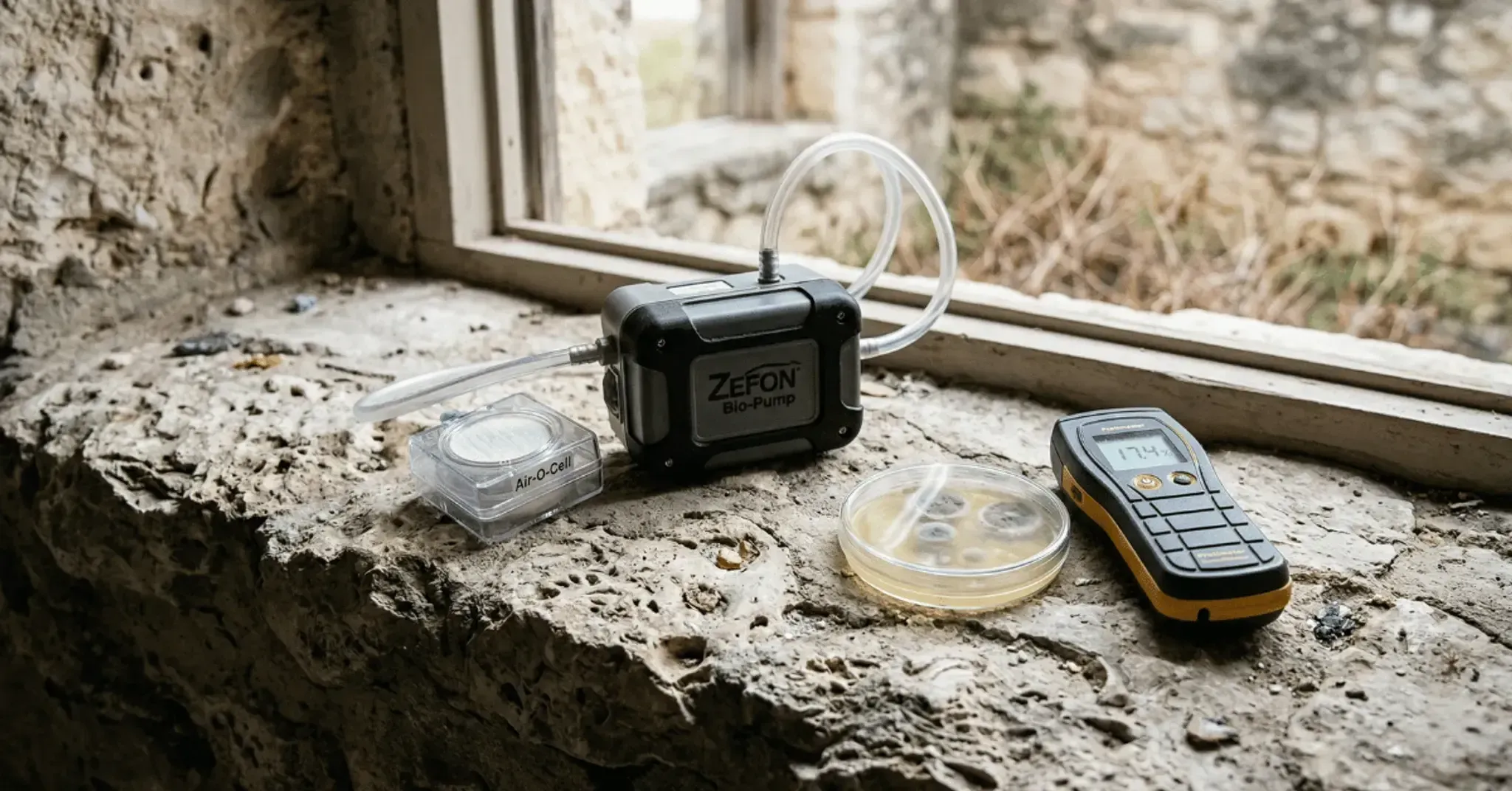
A TDLR-licensed Mold Assessment Consultant comes to your home with a moisture meter and a special camera that checks heat. They move through the home in a planned way and check how much humidity is in the crawlspace. A good range is 50-60% in places close to the coast. A higher number means there is too much moisture. They take photos of where mold grows, like the rim joist and attic decking. These photos often show signs that mold has been there for many years.
Then they go to the spot where water gets in from the storm. At this place, they find that the moisture levels are much higher than normal. They take photos of wet marks that are new, not old. They also show mold growing near where the water got in, which means the mold started there only recently.
In their report, they say both the following things. The crawlspace rim joist has mold growing on it. That kind of mold shows up after years of Gulf humidity, and it was already there before. It is not covered. The east wall on the second floor has new water stains and early mold starting to grow. This happened when storm water came in during March 2025. That is covered.
Your adjuster can now see a clear difference. They can say yes to the storm damage. But they will leave out the old, long-term issue.
Under Texas Occupations Code, only a MAC's signed inspection report can show this to an insurance company in a legal way.
Pier-and-Beam Crawlspace Complexity
Many older homes in Corpus Christi are built on pier-and-beam frames. There is a crawlspace under the house. In most cases, this crawlspace does not have a vapor barrier. The floor is only dirt, open to the Gulf air and groundwater. Mold can grow fast in these spots.
When there is a storm and water gets into the crawlspace, you can face two problems. You may already have high humidity for years. Now, there is also standing water because of the storm.
Your insurance adjuster looks at your lab test and says, "This mold can come from either place, so we do not know if you are covered." So, they say no to your claim.
A MAC check sets them apart by first writing down the normal humidity in the crawlspace before the storm. It also takes pictures of old mold that was there before any damage. Then, it shows new water that came in and any new mold that grew after the storm. This helps the adjuster know how to give the right coverage.
The Order Matters: Inspection First, Testing Second
If you have storm damage, call a TDLR-licensed expert before you start cleaning up. Do not wait until later or when you feel like it.
The inspection checks what is there right now. It shows both the way things were before and any new damage. This is done while both can still be seen. When you start cleaning, a lot of proof goes away. Your adjuster will want to see the inspection report. If you do not have it, you will have to pay for the cleaning yourself.
After you finish the check, you do a test. The lab results help show what the check found. Both the check and the test come together to make your claim file.
Inspection first. Testing second. Cleanup third.
What Insurance Companies Actually Read
Your claim file has photos that show where water got in. It also has moisture meter readings from different spots. There are thermal imaging pictures that show where the water is. The file has baseline readings from the crawlspace and higher readings from where the storm brought water in. You will find lab test results that show what type was found. A signed MAC report is there, and it tells what caused the problem.
Your adjuster looks at this and does not ask any questions. They can approve the mold that was caused by the storm. They do not include damage from any mold that has been around for a long time. They handle the claim as allowed in the policy.
Without the MAC report to split the two, your adjuster looks at the lab test and says no to covering it. This is because they can’t show that the mold is from the storm and not from many years of Gulf air.
FAQs
Why is mold coverage so limited in Corpus Christi policies?
Insurance companies see Gulf humidity as an ongoing upkeep problem, not something they will pay for. They limit mold coverage because people who live on the coast deal with high humidity all the time. Mold that comes from daily moisture is not covered. The plans only cover mold from quick water problems, like storms or broken pipes. Even then, there is usually a $5,000–$10,000 limit.
Can I prove the mold came from the storm?
You need to do a MAC inspection. A lab test can show if there is mold, but it will not tell you when the mold started or how it happened. A MAC assessment will check moisture levels and compare them with the usual readings. It will take photos of the mold so you can see which spots are new and which have been there a while. It also gives reasons for the mold in a signed report. Your adjuster wants this kind of clear proof.
What if I wait to call an assessor until after cleanup?
You have lost your proof because the wet spots are gone. The mold you saw before is not there anymore. You can't get the first readings now. The person checking can only write down what they still find, and that's not much. The insurance adjuster will see there is not enough paperwork. They may use this as a reason to say no. Make sure you get the checkup before you start to clean up.
Does my homeowner policy cover mold from a hurricane or tropical storm?
The insurance covers it only if the water came in directly from the storm. If the mold was already there before, because of the damp Gulf air, it is not covered. Your MAC report will show when the damage happened and what caused it. If you do not have this report, your insurance adjuster will think the worst and not approve your claim.
What if I'm buying a home in Corpus Christi with a history of water damage?
Ask the seller if they have any old MAC inspections and cleanup certificates. If the seller does not have these, you should order your own inspection before you buy the home. A baseline check shows what mold damage was there when you bought it. If there is a flood later, you can show with this check that the damage did not start before you bought the house. Without it, you have no way to prove when the mold damage started.
The Adjuster's Decision Point
Your lab test comes in, and the adjuster looks at it. There is mold. The adjuster says, "When did this start to grow? Did the storm cause it, or is it from all the years of Gulf air?" The lab test does not say when the mold started. So, the claim is denied.
Your MAC assessment comes in, and the adjuster checks the moisture readings. The adjuster looks at these and compares them to the baseline numbers. This helps the adjuster see the difference between the old damage and the damage from the storm. Now, the adjuster has what they need to approve coverage for the storm damage.
If you have had storm damage in Corpus Christi, if you are buying a home that has had water problems in the past, or if you see new mold and want to know if it's covered, schedule a MAC assessment with Fast Mold Testing. This report will let your adjuster know what part of your claim they have to handle and what part is yours.
Frequently Asked Questions
- What documentation do Corpus Christi homeowners need to support a coastal mold insurance claim?
- Corpus Christi coastal mold insurance claims require documentation of the water entry point and its cause, a timeline showing when moisture intrusion began relative to the covered event, a licensed mold assessor's report with moisture readings and lab sample results, and evidence that the mold growth occurred after the covered event rather than pre-existing it. Fast Mold Testing provides all of these components in a single inspection report.
- How does salt air corrosion in Corpus Christi complicate mold insurance claims?
- Salt air corrosion affects metal components like flashing, fasteners, and HVAC equipment in Corpus Christi homes, creating moisture entry points that develop slowly over time. Insurers often argue that corrosion-related moisture intrusion is a maintenance issue rather than a covered event. A professional mold inspection report that documents the specific entry point and correlates it to a covered storm event is essential to counter this argument.
- How much does a mold inspection cost in Corpus Christi for insurance claim documentation?
- Mold inspections in Corpus Christi for insurance claim documentation typically cost between $500 and $800 (more for extensive inspections). Fast Mold Testing offers transparent published pricing with results in 1 to 2 business days. The report is formatted to meet insurance documentation requirements, with moisture source identification, photographic evidence, and lab-verified spore counts that adjusters and public adjusters use directly in claim submissions.
- Should Corpus Christi homeowners get a mold inspection before or after filing an insurance claim?
- Get the mold inspection before filing if possible, because the report documents the condition at the time of discovery and creates your baseline evidence. If the claim has already been filed, get the inspection immediately and provide the report as supplemental documentation. The longer you wait, the more mold spreads and the harder it becomes to establish the original scope and the covered event connection.