
The 2022 to 2023 drought was tough for Austin. The clay under the city got smaller and moved away from the slab edges and the walls. A lot of new cracks opened up. Then the rain was back, and the clay got bigger again. But those cracks did not close all the way.
Three years go by. You smell something in the main bedroom. A contractor comes in and says it is mold. You get a lab test. It shows you do have mold. You clean it up. Six weeks go by. The same smell is back after big rain. You test again. Same answer. You keep cleaning up what you see, but the real cause is still there.
A test will show if there is mold. It does not show if water is coming up through your slab when it rains in Central Texas. Only an inspection can tell you that.
The Crack That Never Healed
Expansive clay gets bigger when it is wet and gets smaller when it is dry. Based on foundational research on Central Texas clay soils, the clay under homes in Austin is some of the most reactive in the state. When there is no rain for a long time, the clay can shrink from 6 to 8 percent. This can make the slab move away from the wall. Cracks can show where pipes and wires go through, and edge cracks show up where concrete and soil meet.
When rain comes back and the clay grows again, the cracks do not close all the way. They stay open because they have already broken the concrete line that stops water. Now, whenever there is heavy rain, water goes through these cracks. It then goes up into the framing of the house. This process is capillary migration. It happens slowly and you can't see it at first. Water can travel 8 to 10 feet up into the wall before you notice any color change on the surface.
When you smell mold in your home, it means water has been inside your walls for weeks.
Why a Test Misses the Pattern
A mold lab test takes air samples and tells you what types are in the air. "Aspergillus at 650 spores for every cubic meter. This is higher than outside levels." The lab is right. Mold is in your home. After your contractor removes it, you feel better.
Then July comes, and there is more heavy rain. The ground gets soaked again, and water moves up through the same crack. In about two weeks, mold shows up in the same place. You call another mold company, have a new test, and get the same result.
You have now done two tests. You have also paid for two cleanings. The crack is still there. Water is still coming up. A test can tell you what is growing at this time. It will not show you that, every August and September, when Central Texas gets a lot of rain, the same water path starts again.
Only an inspection that uses moisture meter readings and a heat camera can show you that pattern when it comes up again.
Austin's New Construction Trap
The construction surge between 2020 and 2024 led to a lot of new homes in Austin. A lot of these homes were built under strict drywall schedules. Many builders poured the slabs during the spring. Then, they closed in the houses before the summer heat could dry the concrete all the way. The framing of the houses started while the slab still held in moisture.
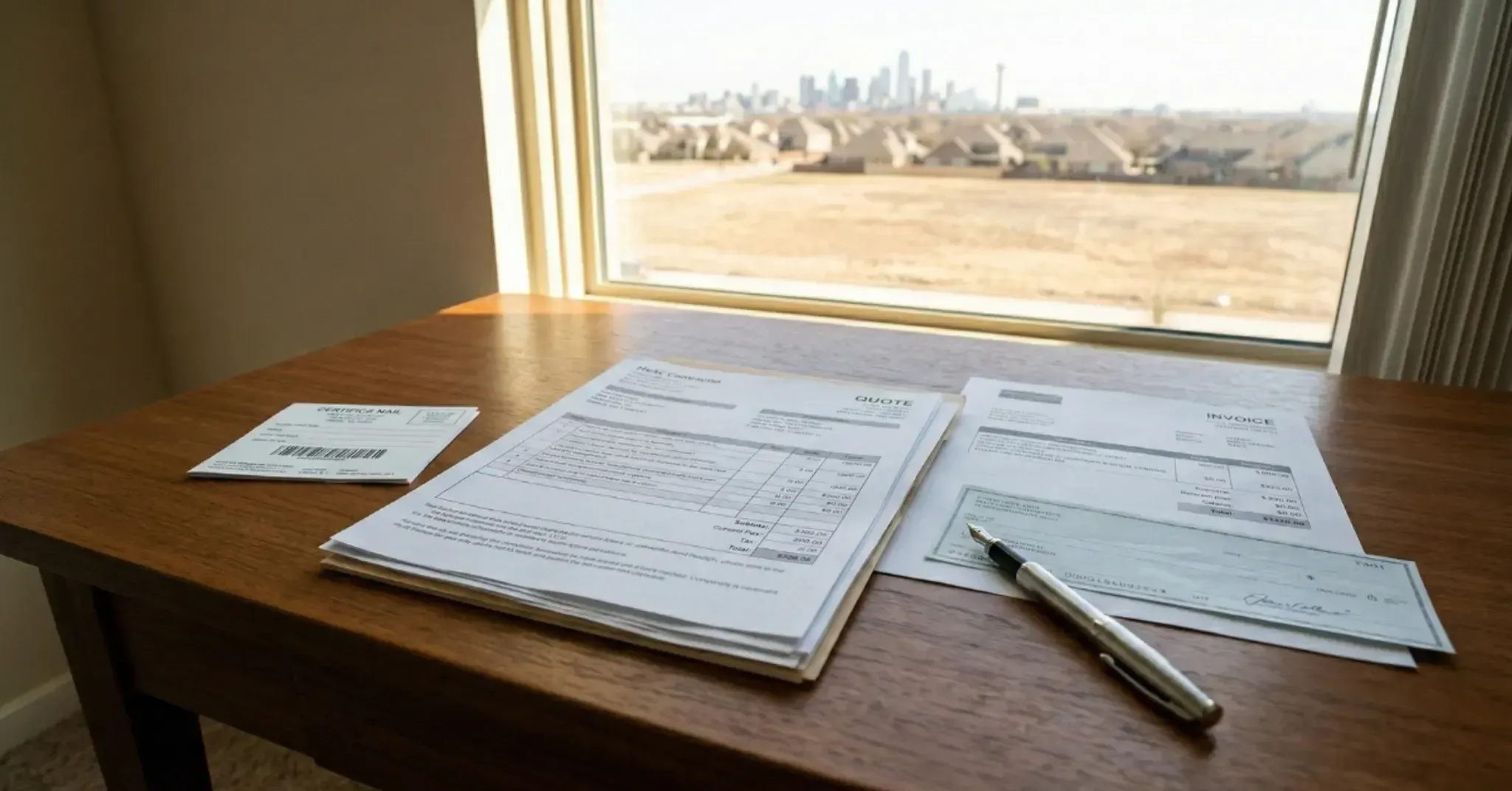
At closing, the builder gave you only one paper. It is called a "dry out sign-off" or a "moisture certificate." This paper says the slab reached a good moisture level on a certain day. It is not a starting point. It is not a checkup. It is just a record from that day.
Under Texas Occupations Code Chapter 1958, that certificate does not count for anything by law. If mold comes up two years from now and you try to make a claim, your insurance company will ask when the problem started. They will also ask if the home was already wet when you got it. You have no TDLR-licensed MAC checkup to show the starting condition when you bought the home.
The builder's certificate says the concrete was dry on October 15, 2021. That is all you get from it. This does not mean the home did not get wet again before they closed the framing. It also does not mean the crack did not start leaking water some months after that.
If you bought a new Austin home and have never seen a TDLR-signed MAC assessment, that is a gap in your paperwork. Get one now. The assessment will show the true moisture baseline for your house and will be added to your home file for good.
The Inspection That Shows What's Hidden
A TDLR-licensed Mold Assessment Consultant (MAC) will come with a moisture meter and a heat camera. They go to the edges of the slab and check moisture in many spots around the sides. They check the numbers against the starting point, which is about 16 percent for concrete. If they see a reading of 24 percent, 28 percent, or higher at an edge, they know water is coming up through that slab.
They use a camera that makes a special picture, and it shows a cold spot on the edge. A cold spot can mean there is water turning into vapor. When this happens, it pulls heat away from the surface. This shows that water is moving in the area.
They make a report that shows the moisture readings, heat findings, where the water came in, and the pattern. The MAC signs this, so it is a legal paper under Chapter 1958. A cleanup team can use it, and an insurance company can trust it.
The lab test is part of what you get. But getting the result of the test alone would not be enough to start this check.
How the Inspection Stops the Cycle
Once the MAC report finds the crack and the water pathway, a licensed cleanup crew can seal it. The work plan from the MAC shows what steps to take. They will seal the crack. Then they dry out the wall spaces. Next, they take out any mold. After that, they check if the cleanup is good with testing done after the work is finished.
After the problem is fixed, the moisture levels go back to normal. When it rains again, the levels stay normal. The problem does not return.
This is what sets a short-term fix apart from a long-term one. Just checking is not enough to end the problem. Only a look that finds the real cause can do that.
FAQs
How do I know if my slab crack is still weeping?
Take moisture readings at the edge of the slab. A good starting level to look for is 16 percent relative humidity. If you get readings of 20 percent or more, especially after rain, water is still moving in. Get a MAC assessment to check the pathway.
Can I just seal the crack myself?
You can try to seal the top, but that often does not work. If the crack goes deeper than the top of the slab or if water is coming up from underneath, the seal will not hold. A MAC assessment lets you know if you can fix it yourself or if you need help from a pro. Without this, you are just guessing.
What's the difference between a builder's dryout report and a MAC assessment?
A builder's report checks slab moisture for one day. A MAC assessment does more. It sets a starting point. The report shows where water gets in. It also shows how the moisture spreads. A MAC report will also plan the right steps to fix things if needed in a way that follows the law. In Texas, Chapter 1958 says that only the MAC report can be used for legal reasons.
Does every Austin home built 2020–2024 have this problem?
Not every home had this problem. But many concrete slabs did not get enough time to cure, and cracks caused by lack of water are common for homes built then. If your home has signs like a musty smell after it rains, stains that keep coming back, or mold that grows again after you clean, you should get the house checked. You may have this problem.
Will my insurance cover drought-related mold?
Standard homeowner plans do not cover mold caused by building mistakes or problems from not keeping up the home. If your new place gets mold because of a building problem, your insurance company will not help pay for it. The best way to not get caught in this trouble is to use an early checkup of the home when you close the deal. This is the only way you can keep safe from this kind of problem.
The Moisture Pattern Your Test Will Never Show
Every time there is heavy rain, water comes up through the crack. In about two weeks, you start to smell mold. You clean it up, but after two months, it rains again. The same thing keeps happening.
That pattern can't be seen in a lab test. A test in May will show there is mold, and a test in July will also show mold. But the test does not explain why the same mold comes back in the same spot every time it rains.
Getting moisture readings during the whole wet season can show the pattern. This proves that the crack is active. It shows there is a good reason to spend money to seal it. This also helps to stop the cycle from happening again.
If you live in Austin and your home was built during the busy building years, you may notice musty smells when it rains. If you have cleaned up mold more than one time in one spot, schedule a MAC assessment with Fast Mold Testing. This checkup shows your starting level of moisture and points out the crack that leaks now and then. Their clean-up plan helps put an end to having to scrub mold over and over.
Frequently Asked Questions
- Does Austin's drought actually reduce mold risk, or can mold still develop during dry periods?
- Austin's drought conditions reduce outdoor mold spore levels but do not eliminate indoor mold risk. During drought, HVAC systems work harder, producing more condensate that can overflow drain pans or leak into wall cavities. Cracked foundations and dried-out plumbing seals during drought can create new moisture entry points that feed indoor mold even when outdoor humidity is low.
- What is the difference between mold testing and mold inspection in Austin during drought conditions?
- In Austin during drought, a mold inspection focuses on identifying HVAC condensate issues, foundation crack moisture intrusion, and dried-out plumbing seal failures as the most likely moisture sources. Mold testing adds air sampling to quantify whether these drought-specific moisture sources have already produced elevated indoor spore levels. Fast Mold Testing combines both in a single Austin inspection at a transparent published rate.
- Should Austin homeowners get mold testing or mold inspection when buying a home during a drought year?
- Both. A mold inspection identifies the moisture sources that drought has either created or masked, and mold testing with air sampling confirms whether any of those sources have already led to indoor contamination. Buying an Austin home during a drought without both components leaves you without knowledge of conditions that may become obvious only when rains return and dormant mold reactivates.
- How much does a mold inspection cost in Austin and how is it different from testing alone?
- A comprehensive mold inspection with testing in Austin from Fast Mold Testing comes at a transparent published rate and delivers results in 1 to 2 business days. Testing-only services using basic settle plates cost less upfront but provide no moisture source information, no thermal imaging, and no professional moisture mapping. The full inspection is the only service that tells you both whether mold is present and why, which is what you need to actually fix the problem.