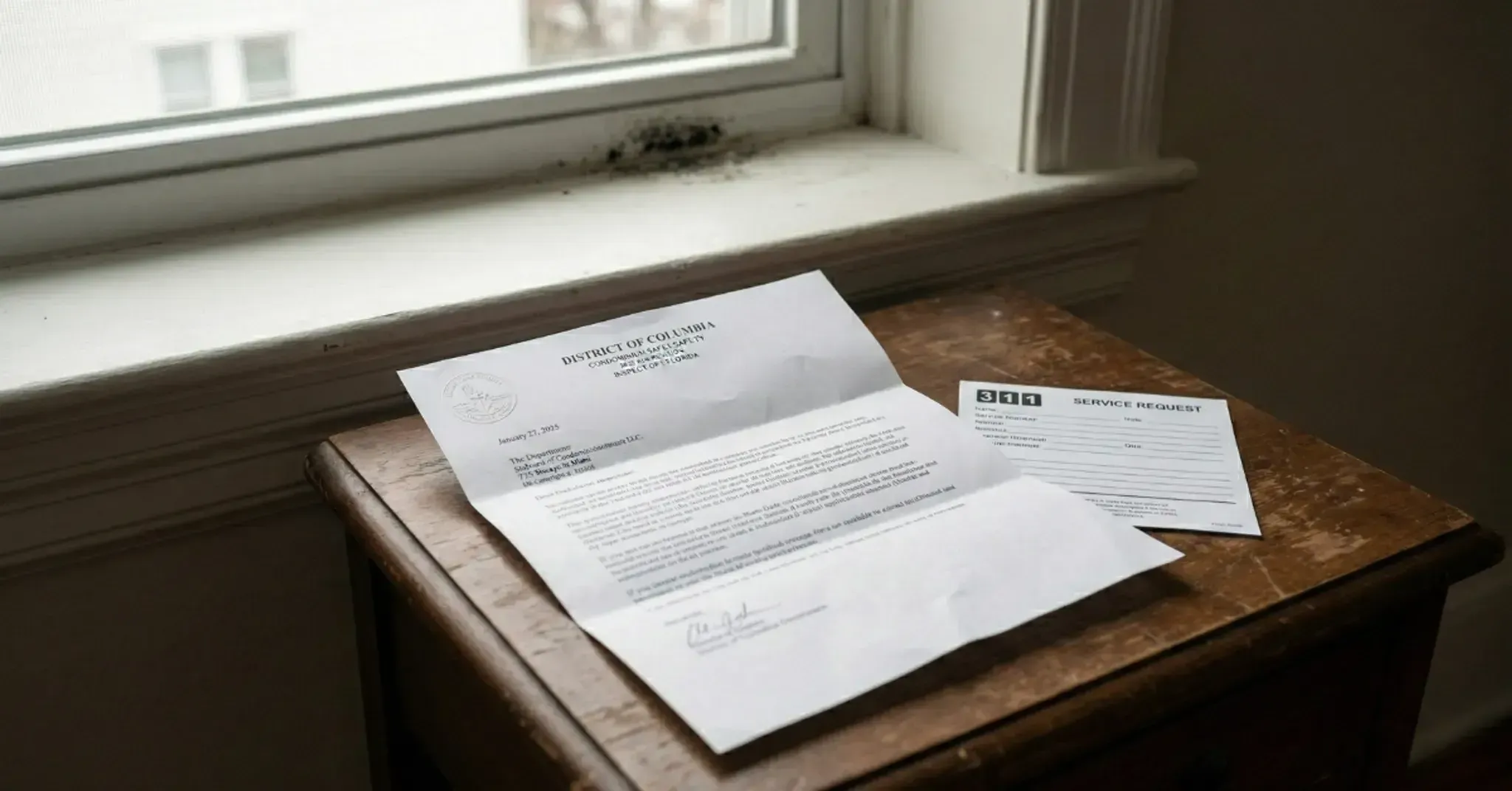

If you're a DC tenant who called 311 about mold and nothing happened, you didn't do anything wrong. The system is built in a way that almost guarantees nothing happens, and most tenants don't find out why until they've already wasted weeks waiting.
Here's the short version: the city agency that handles housing complaints doesn't have authority over mold. And the city agency that does handle mold only looks at what it can see with its eyes. Together, those two limits create a gap that a lot of landlords know how to use. Mold testing in DC runs about $500 to $800 (more for extensive inspections), and Fast Mold Testing starts at our transparent rate with results in 1 to 2 business days.
The Agency That Handles Your Complaint Can't Actually Cite the Mold
When a 311 housing complaint comes in, it gets routed to the Department of Buildings. DOB enforces DC's housing code, which covers things like broken heat, pest problems, water leaks, and structural issues. That's a real list of things they can act on.
Mold isn't on it.
What DOB can do is cite your landlord for the water leak or the broken pipe that's causing the mold. They show up, see the mold, write "evidence of moisture" in their notes, and issue a violation for the water source.
The landlord patches the leak. The violation gets cleared. The mold, which was already growing inside the wall before any of that happened, stays exactly where it is.
So from the landlord's perspective, the complaint is done. From your perspective, nothing changed except the ceiling stopped dripping.
DC Has a Free Mold Program, but It Has Real Limits
You might come across the DC Department of Energy and Environment when you're looking into your options. DOEE runs a free mold inspection program for DC renters, and it sounds like the answer.
A city inspector comes out at no cost and looks at the mold situation in your unit. Their mold program page explains how to request one.
The catch is what they actually do when they show up. DOEE inspectors do a visual check. They look at what's visible, write down what they saw, and produce a report based on that.
No air samples. Nothing goes to a lab. You get a document saying an inspector came and observed mold, which is useful as a paper trail but not much else.
This matters because DC's strongest tenant rights require something more specific. Under DC mold law, the written report that starts the 60-day clock must come from a licensed mold assessor. A DOEE visual doesn't qualify.
A lot of tenants go through the DOEE process expecting it to create legal leverage, and it doesn't, not in the way they're hoping.
Why Landlords Aren't Worried About the City Process
Experienced DC landlords know how the DOB and DOEE systems work. They know a 311 complaint results in a visit about the water source, not the mold. They know a DOEE visit produces a visual report with no lab results and no legal trigger. They can fix the visible leak, get the DOB violation cleared, and let the DOEE report sit on file without ever having to deal with what's actually growing behind the wall.
This isn't technically illegal. It's just how the system works when you stay inside it. Tenants who follow the standard advice, call 311, wait for DOEE, and wonder why the landlord isn't moving, are dealing with a situation where the landlord has no real legal pressure on them yet. The pressure only comes from outside the city process.
What Actually Creates Legal Pressure on Your Landlord
DC law gives tenants real tools, but those tools get activated by a private licensed assessment, not by a city program. Once a landlord receives a written mold report from a DC-licensed assessor in writing, the 60-day clock starts. If the landlord ignores the problem in bad faith for 60 days after that, a court can award the tenant triple damages. That's a significant threat, and it's one landlords take seriously in a way they don't take a DOEE visual.
A licensed private assessor does things the city programs don't. Air samples go to an accredited lab. Surface swabs get analyzed.
The report comes back with the mold species, spore levels, and a comparison to outdoor air samples from the same day. That comparison shows the mold in your unit is worse than what's outside, not just present.
The DC Office of the Attorney General's tenant resources page covers the broader legal landscape for renters dealing with housing issues.
Fast Mold Testing Washington DC produces the licensed assessments that meet DC's legal standard, with lab results in 1 to 2 business days.
What to Actually Do if Your Landlord Is Ignoring Mold
Start with the 311 complaint anyway. It creates a dated record that you reported the problem and the city received it. That record is useful later even if it doesn't solve much right now.
Then contact DOEE and schedule their free visual inspection. Not because it triggers anything on its own, but because it adds another layer to your paper trail.
After that, get a licensed private assessment. That's the step that changes your legal position.
When you hand that written report to your landlord, the 60-day clock starts. You're no longer waiting on a city process. You have a document that creates real problems for them if they don't act.
Frequently Asked Questions
Will calling 311 hurt my case?
No. File the 311 complaint and file it early. It shows you reported the problem and the city acknowledged it, which is useful in any dispute later.
The problem isn't that 311 hurts you. It's just that it won't fix the mold on its own.
Does the DOEE inspection cost anything?
It's free for DC renters. Schedule it and get the report. Just don't treat it as the finish line. It documents what was visible, but it doesn't produce lab results and it doesn't trigger the legal remedies that come from a licensed private assessment.
What counts as a "licensed mold assessor" in DC?
DC requires mold assessors to hold a license issued by DOEE. This is separate from a general home inspector license. Ask any inspector you're considering whether they hold a DC mold assessor license specifically, and confirm it before you hire them. An unlicensed report, even a detailed and accurate one, doesn't start the 60-day clock under DC mold law.
My landlord says they already fixed it. What now?
If you can still see mold or still smell it, the fix didn't work. A post-repair clearance test runs new air and surface samples to confirm the mold is actually gone, not just covered up. If the numbers come back elevated, the landlord's claim that the problem is resolved doesn't hold up.
The Private Report Is What the City Programs Were Never Built to Provide
DC has genuinely strong tenant mold protections on paper. The limitation is that those protections require a specific document the city's own programs don't produce. A 311 complaint and a DOEE visit are both worth doing, but neither one gets you to the 60-day clock or the triple damages option. A written report from a licensed private assessor does.
Book a licensed assessment through Fast Mold Testing Washington DC and have the report that actually puts your landlord on the clock.
Related reading
Frequently Asked Questions
- Why doesn't a DC 311 mold complaint actually get my landlord to fix the problem?
- DC 311 routes mold complaints to DCRA or DOEE depending on how the call is classified, but neither agency has dedicated mold inspectors. Inspectors often see only what is visible on the day of the visit and may not have the tools to find hidden moisture. Without a moisture reading and lab sample, the complaint rarely produces a binding repair order.
- What should DC tenants do instead of relying on 311 for a mold problem?
- DC tenants should get a private mold inspection from Fast Mold Testing before or alongside any 311 complaint. The private report gives you moisture data, lab results, and a source finding that agency inspectors typically cannot provide. That documentation supports an OTA complaint, a lease withholding argument, or a Superior Court action far more effectively than a 311 ticket.
- How much does a mold inspection cost in Washington DC for a rental unit?
- Mold inspections in Washington DC for rental units typically cost between $500 and $800 (more for extensive inspections). Fast Mold Testing starts at our transparent rate with results in 1 to 2 business days. The report documents the type, location, and moisture source of mold in a format that DC housing attorneys and OTA hearing officers recognize.
- Can DC landlords be fined for ignoring mold even if the 311 complaint was closed without action?
- Yes. The DC Housing Code requires landlords to maintain units free of moisture and mold regardless of whether a 311 complaint was resolved. Tenants who file an OTA complaint with independent lab results from Fast Mold Testing are far more likely to get a binding repair order and rent reduction than those relying solely on a closed 311 ticket.