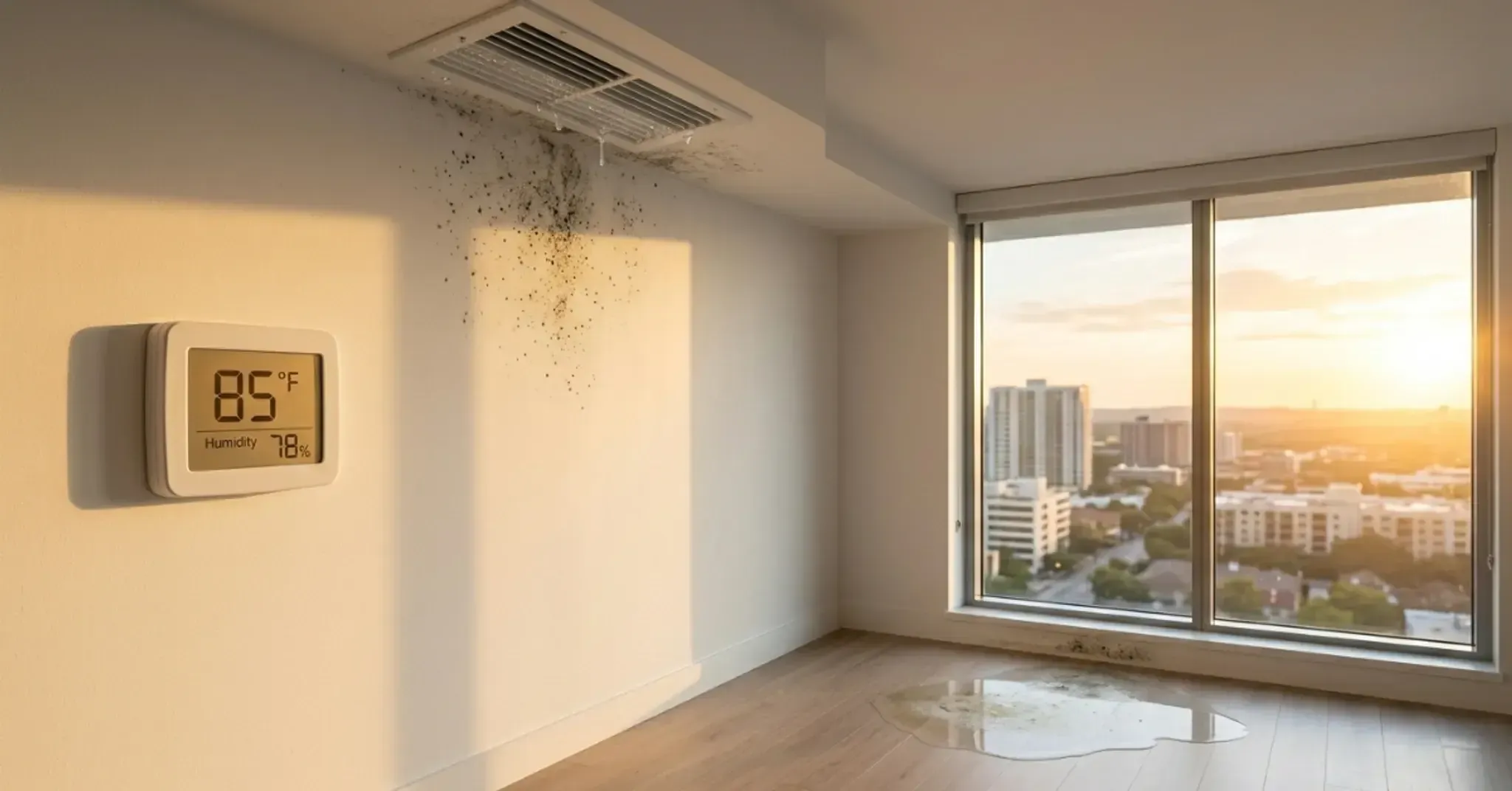

Starting July 2025, all rental homes in Austin must keep the indoor air at 85°F or lower. The inside of the place also needs to be at least 15 degrees cooler than outside air. This rule is a part of the city's Property Code, and it covers apartments, duplexes, and houses.
To reach those temperatures in July and August, AC systems stay on longer and blow colder air than before. This makes water build up inside the outside of ducts, fills up drain pans, and keeps wetness trapped in wall spaces. A rule that was put in place to keep renters safe is now causing a new problem—the risk of mold. Mold inspection in Austin can cost from $500 to $800 (more for extensive inspections). Fast Mold Testing offers transparent published pricing and you can get results in 1 to 2 business days.
What Austin's 85-Degree Rule Actually Requires
Austin City Council put the cooling rule into the Property Maintenance Code in the middle of 2025. The rule started on July 10, 2025. This rule is for all homes in Austin, even rentals.
The two numbers you need to remember are easy. Indoor air should not get hotter than 85°F. The inside must be at least 15 degrees cooler than the air outside. Both rules need to be followed.
On a hot day in Austin when it's 102 degrees outside, the inside needs to be at or below 85°F. If it's 95 degrees outside, then the inside should cool down to 80°F or less. A lower temperature in your home means the AC needs to run longer. The City of Austin Code Compliance page lists the current rules for what rentals should have.
Why an Overworked AC Creates Moisture in Walls and Ducts
Air conditioning takes out heat and water from the air. When the system runs for short times, water goes out the right way. If it runs longer at cooler settings, some problems start to happen.
The first problem to look at is the condensate drain pan. In many older Austin rentals, the drain pan is made for units that run for a short time. If the unit runs longer, more water is made. This can fill up the pan before the drain can take all of it away. When this happens, water goes back into the air handler.
The second problem is duct sweating. Cold air ducts that go through hot attics get water on the outside. That water drips onto the insulation and ceiling drywall. Most people don't see it until a brown mark shows up.
The third problem is cold wall cavities. When supply vents blow cool air into these spaces, the drywall gets cold. If the air in Austin is humid, it can reach a point where water starts to gather on the drywall. You do not need a leak from outside for moisture to build up inside the wall.
The Places Mold Shows Up First When AC Runs Harder
Austin landlords who want to follow the 85-degree rule should look at a few key spots. The first place to check is the condensate drain lines and pans. A drain line that was clear before can back up when the air runs longer.
Attic air handlers are the next place to check. You can look at the insulation on the unit and the supply plenum. The color or shape of the insulation can tell you what is happening. If you see the insulation getting dark or starting to hang down, there might be water collecting. This is sometimes the first spot where people notice a musty smell in the hallway under the attic.
The supply vents and the drywall close to them are next. Put your hand near the edge of a supply vent in July. If you feel that it is wet, or you see that paint bubbles by the vent, then water is meeting the surface. The mold can grow there if this keeps happening for a few weeks in Austin's weather.
Bathroom fans are the fourth spot. When the air cool system has to work more, the water in the air from hot showers has to go somewhere. Fans that were just getting by before the rules changed may now not keep up. This lets water in the air stay on tiles, in the gaps of caulk, and soak into wall paint.
What Landlords and Tenants Should Check
For landlords, the fastest way is to look every three months at the condensate drain line, the pan, and the insulation near the air handler. These tasks are small and do not cost much. They help you find problems early.
For tenants, there are certain things you should watch for. A strong musty smell that gets worse when the AC starts is one. You might also see water stains on the ceiling drywall close to vents.
Paint bubbling close to supply registers can happen. Also, some people feel allergy signs get worse inside the rental, but feel better when out of it.
Austin Code does not check for mold itself. The city's site says this very clearly. But Austin Code does take a look at the things that make mold happen. This is for things like leaks, vent issues, and open spots in the building that should be sealed.
A 311 complaint about these conditions can make the building owner fix where the water is coming from, instead of trying to fight the mold once it is already there. Fast Mold Testing Austin runs the check that lets you know if a musty smell is just a signal or if there is another problem starting up.
Frequently Asked Questions
Does the 85-degree rule apply to every rental in Austin?
Yes. This rule is in the Property Maintenance Code. It applies to every home in the Austin city area. This includes homes like apartments, duplexes, townhomes, and single-family rentals.
Who pays if mold shows up after complying with the cooling rule?
This can depend on the lease and what caused the problem. If the mold was made by condensation from the HVAC system, the person who owns the place often has to fix it. If the person who rents the place made the moisture problem by not letting air move or not telling about a leak, things can change. A mold report in writing can help everyone know what to do.
Will Austin Code inspect for the mold itself?
No, Austin Code does not check or test for mold. They look for problems that go against city rules and can cause mold. These might be leaks, broken AC units, or problems with air flow. Mold inspectors in Texas need a special license from the Texas Department of Licensing and Regulation.
What's the temperature the unit should actually run at?
The rule is you need to keep it at or below 85°F. There must also be a 15-degree difference from the outside temperature. A lot of Austin landlords set the thermostat between 75 and 78°F. They do this to stay safe with the rule. This helps to be in line with rules. But this can also make the AC work more. That's when the risk for mold goes up.
Mold Risk Is Now Built Into Austin's Rental Standard
Austin's cooling rule helps people who rent homes. It is very useful during hot weather in the summer, and it is here to stay. Still, there is a new risk now. Most landlords do not check for extra moisture that can come with this rule.
Checking drain lines, attic air handlers, and supply vent drywall costs little. A mold test when something feels wrong costs less than fixing a whole wall. Book an assessment through Fast Mold Testing Austin and catch the problem early while it is still small.
Frequently Asked Questions
- Can Austin tenants hold landlords responsible for mold caused by the 85-degree cooling rule?
- Yes, under the Texas Property Code, people who own the place have to keep the place safe to live in no matter what started the moisture. So if following the 85-degree rule causes water drops from the AC and mold starts, the owner is still the one who needs to fix it.
- How much does a mold inspection cost in Austin for a rental affected by AC condensation?
- In Austin, mold checks for rentals with AC water problems usually cost from $500 to $800 (more for extensive inspections). The price depends on how big the place is and how many samples are done. With Fast Mold Testing, pricing is transparent and published before you book. You get your results in 1 to 2 business days.
- What signs of AC-related mold should Austin renters look for after the cooling rule took effect?
- Austin renters should watch for water stains near supply vents. A musty smell that gets stronger when the AC turns on is also a sign. They should look for water drops on ductwork or nearby walls. A drain pan that spills over can also be a sign. These things show the cooling system is putting more water in the air than it takes out.
- Should Austin landlords get a mold inspection before summer to comply with the new cooling rule?
- A mold inspection before summer is a good idea for Austin landlords. It helps you check and write down moisture levels and duct work before running the AC all the time. This way, if mold starts to show up, you have proof that you did your part.